
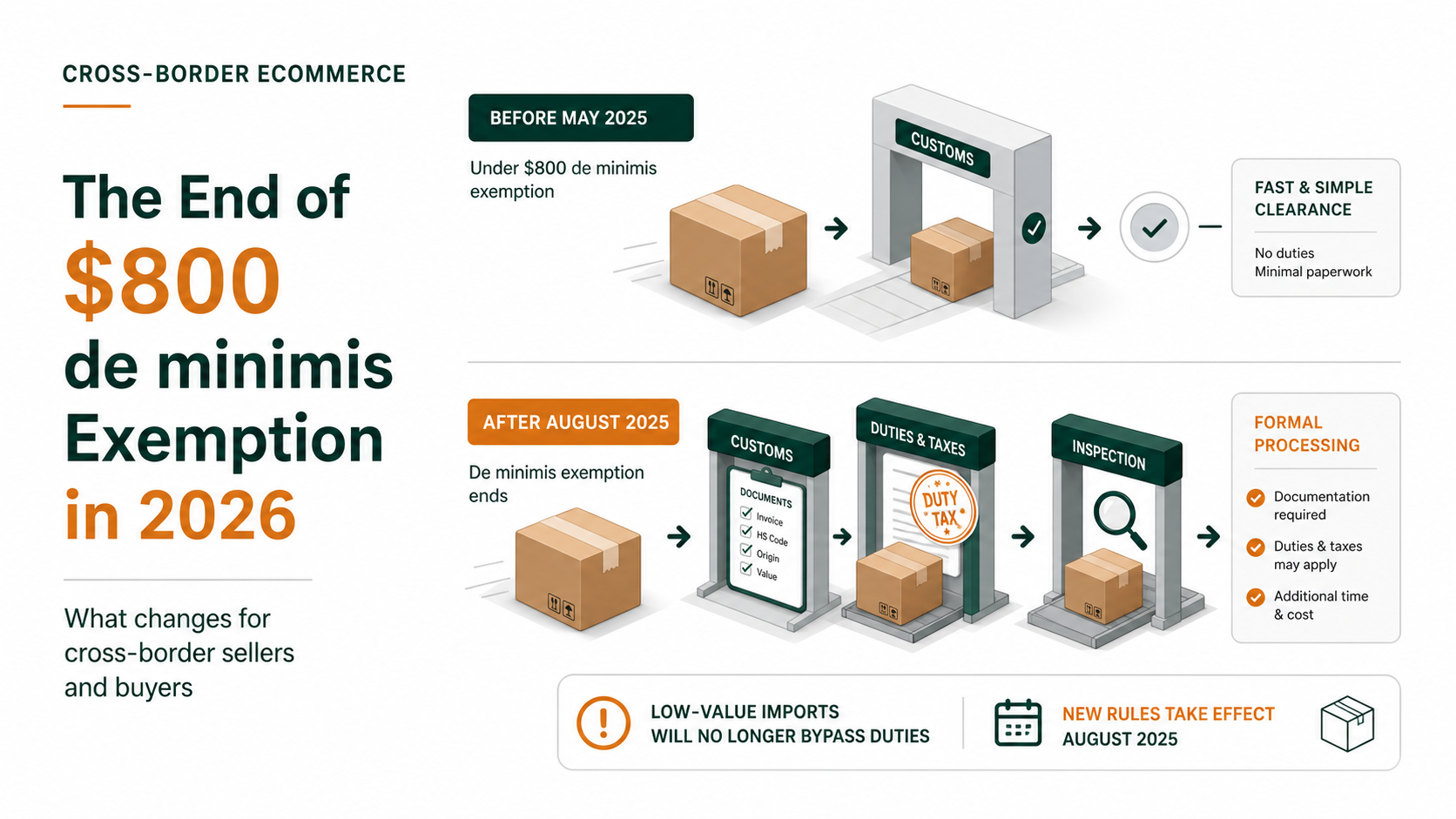
TL;DR: The old “ship under $800 and avoid duty” playbook is no longer something cross-border sellers can safely build around. China / Hong Kong shipments were hit first, then low-value treatment changed globally. The practical planning question is now carrier path, origin, HTS classification, and whether your fulfillment model can survive formal customs processing.
For years, de minimis was the oxygen in direct-from-factory ecommerce. A $28 accessory, a $49 dress, a $120 gadget: ship it directly to the U.S. consumer, keep each shipment under $800, and avoid the same duty stack a bulk importer paid.
That arbitrage is exactly why the rule became politically radioactive.
What de minimis used to do
Section 321 of the Tariff Act allowed qualifying shipments valued at $800 or less to enter the United States duty-free with simplified processing. The rule made sense when low-value packages were a small administrative edge case. It became a business model when marketplaces and DTC sellers began routing enormous parcel volume through it.
The result was a strange split:
- Bulk importer: pays MFN, Section 301 if China-origin, possible AD/CVD, MPF/HMF.
- Direct parcel seller: often paid none of that on a sub-$800 consumer shipment.
That split is what regulators moved to close.
What changed
The short version: low-value imports are no longer a safe “no duty” assumption. China / Hong Kong de minimis treatment was suspended first, and later policy expanded the change to all countries. Implementation details vary by carrier, entry type, and official guidance, so you should verify the live CBP rules before filing or pricing.
For planning, assume every U.S.-bound parcel needs a duty answer:
| Origin path | Old planning assumption | Safer 2026 planning assumption |
|---|---|---|
| China / Hong Kong postal parcel | Often duty-free if under $800 | Formal or special low-value processing with tariff exposure |
| China commercial carrier | Often simplified low-value entry | MFN + China-specific layers may apply |
| Vietnam / India / Mexico direct parcel | Often duty-free if under $800 | HTS base and current U.S. policy layers may apply |
| U.S. warehouse fulfillment | Bulk import pays duty once | Still viable, but requires capital and inventory risk |
Postal vs commercial: why sellers see different numbers
Two sellers can ship similar products and see different landed costs because their parcels move through different channels. Postal networks, express carriers, customs brokers, and marketplace logistics providers do not always expose charges the same way.
The three questions to ask your carrier or 3PL:
- Which entry type will be used?
- Who is importer of record?
- Which duty, fee, and brokerage charges will be passed to the customer or seller?
If the answer is “we handle customs,” ask for a sample landed-cost invoice. “Handled” is not the same as “free.”
The new decision tree for cross-border sellers
Option 1: Move fulfillment into the United States
You bulk import inventory, pay duty once, and fulfill domestically. This usually improves delivery time and customer experience, but it ties up working capital and creates inventory risk.
Best fit: repeatable SKUs, stable demand, high review sensitivity, low obsolescence.
Option 2: Move real production out of China
Vietnam, India, Mexico, and other origins can reduce China-specific tariff exposure. The word “real” matters. Repacking or relabeling Chinese-origin goods is not substantial transformation.
Best fit: products where the non-China cost premium is lower than the avoided tariff layer.
Option 3: Keep direct shipping and raise prices
This is viable only if the product has brand pull, urgency, or margin cushion. Commodity dropshipping products rarely survive a large customs cost surprise.
Best fit: differentiated products, loyal audience, high gross margin before duty.
Option 4: Exit or pause U.S. direct shipping
This sounds dramatic, but for low-AOV goods with thin margins, it can be rational. A policy shift that adds $8 of cost to a $19 product is not an optimization problem. It is a business model problem.
What to model before changing the business
Use a planning worksheet with these fields:
| Field | Why it matters |
|---|---|
| 10-digit HTS code | Determines MFN base rate and many trade-remedy triggers |
| Origin country | Determines China-specific and preference-program exposure |
| Carrier / entry path | Determines how duty and fees are assessed |
| Declared value | Drives percentage-based duty |
| Fulfillment model | Determines whether duty is paid per parcel or bulk import |
| Return rate | Direct shipping gets ugly when customs cost meets returns |
Then compare unit economics:
Direct parcel margin =
  selling price - product cost - international shipping - duty/fees - platform fees - expected returns

US warehouse margin =
  selling price - product cost - bulk import duty allocation - domestic fulfillment - storage - platform fees
If the U.S. warehouse model wins only when sell-through is perfect, assume it does not win.
What this means for Amazon, Shopify, and TikTok Shop sellers
Amazon FBA sellers already understand bulk import pain, but de minimis changes raise the cost of “test with direct shipping, then bulk order later.” Shopify and TikTok Shop sellers feel it more directly because they often used supplier-direct fulfillment as the default.
The new healthy workflow is:
- Test demand with very small batches.
- Classify the product before scaling.
- Model landed cost under current policy.
- Choose U.S. warehouse or real alternate-origin production.
- Keep source snapshots for the assumptions you used.
That sounds slower. It is. But it is cheaper than scaling a SKU whose margin was secretly funded by a customs loophole.
Sources to verify
- CBP e-commerce import guidance for low-value imports.
- White House Executive Order on suspending duty-free de minimis treatment for all countries.
- Federal Register and CBP CSMS messages for effective dates and implementation.
- Carrier / broker documentation for your actual entry path.
Use the TariffsChart calculator to model the cost change and save a source-backed scenario before you place the next purchase order.
Last updated: May 13, 2026.
Planning estimate only. TariffsChart is not a customs broker, law firm, or official customs database.