
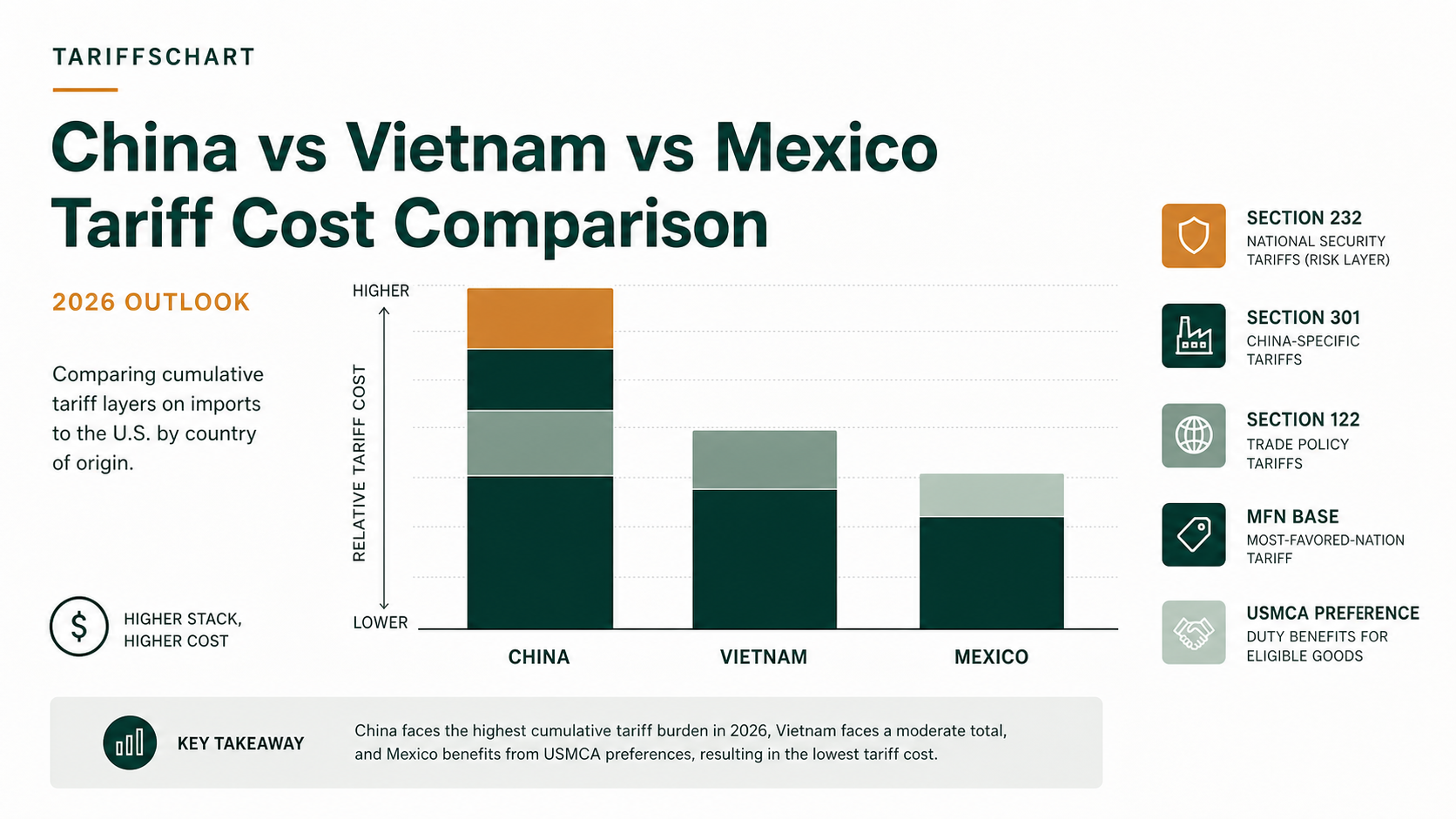
TL;DR: China, Vietnam, and Mexico can produce the same commercial product, but the U.S. duty stack can be radically different. China often carries Section 301. Vietnam often avoids China-specific layers but still needs HTS and current policy review. Mexico can be powerful under USMCA, but only if the product actually qualifies. “Made in Mexico” is not the same thing as USMCA-compliant.
Sourcing teams love country comparisons because they feel decisive. China is expensive. Vietnam is safer. Mexico is nearshore. Done.
Reality is messier. The same SKU can move through three origins with three different tariff stories, and the cheapest factory quote may not produce the cheapest landed cost.
The comparison that matters
Do not compare factory cost alone. Compare:
Total landed cost =
  factory cost
  + freight and insurance
  + MFN base duty
  + origin-specific tariffs
  + product-specific trade remedies
  + customs/brokerage/handling fees
  + operational risk cost
That last line is where many spreadsheet models lie. Delays, rejected origin claims, AD/CVD exposure, and supplier transition failures are real costs.
Country-by-country planning picture
| Origin | Main advantage | Main risk |
|---|---|---|
| China | Deep supplier base, cost, speed, mature tooling | Section 301, AD/CVD, policy volatility |
| Vietnam | Avoids China-specific Section 301 for real Vietnamese origin | Higher factory cost, capacity limits, origin documentation |
| Mexico | USMCA potential, shorter lead time, nearshore operations | USMCA qualification, labor/capacity cost, non-compliant goods lose the benefit |
The duty answer is not “Vietnam good, China bad, Mexico free.” It is “what is the HTS code, what is the origin rule, and what can you prove?”
Example 1: cotton T-shirt
| Origin | Planning duty logic |
|---|---|
| China | MFN apparel rate plus possible Section 301 List 4A exposure |
| Vietnam | MFN apparel rate, no China-specific Section 301 if origin is real |
| Mexico | Potentially duty-free under USMCA if textile rules are satisfied |
For apparel, Mexico can look magical until you read the textile rules. Yarn-forward and regional content requirements are not decorative footnotes. If the fabric, yarn, or production chain fails the rule, the benefit may disappear.
Example 2: lithium battery product
| Origin | Planning duty logic |
|---|---|
| China | MFN plus strategic Section 301 exposure for relevant battery lines |
| Vietnam | MFN plus non-China policy layers, no China Section 301 |
| Mexico | Possible USMCA benefit, but battery content and origin rules need review |
Battery products are where China-to-Vietnam shifts can make obvious financial sense. But if the product is merely assembled in Vietnam from Chinese cells, origin analysis becomes the entire question.
Example 3: steel pipe or metal goods
| Origin | Planning duty logic |
|---|---|
| China | Section 232 exposure plus possible Section 301 and AD/CVD |
| Vietnam | Section 232 exposure may still apply; AD/CVD risk depends on product/order |
| Mexico | USMCA may help base duty, but Section 232 can still matter |
For metal goods, changing origin does not automatically remove product-specific trade remedies. Section 232 and AD/CVD can follow the product category, not just the country.
The substantial-transformation trap
The most dangerous sentence in sourcing is: “We can ship it through Vietnam.”
If the good remains Chinese-origin after minimal processing, declaring it as Vietnamese-origin is not optimization. It is customs fraud. U.S. origin rules ask whether processing created a new and different article with a new name, character, or use. For textiles, special rules can be even more prescriptive.
Safe signs:
- Real manufacturing steps happen in the claimed country.
- The production record supports the country-of-origin claim.
- Supplier invoices, bills of materials, process photos, and shipping records line up.
- A broker or customs attorney can explain the rule in writing.
Danger signs:
- Only repacking, relabeling, sorting, or quality inspection.
- The supplier refuses to provide bill of materials or production flow.
- The savings exist only because nobody is documenting origin.
How to decide whether to move a SKU
Use a simple scoring model:
| Question | Why it matters |
|---|---|
| Is the Section 301 saving material? | If the saving is only 7.5 points, operational risk may overwhelm it |
| Does the new origin raise factory cost? | Many alternate origins cost 10-25% more |
| Is the origin claim documentable? | If not, the tariff saving is not bankable |
| Does the product face AD/CVD or Section 232? | These layers may survive origin changes |
| Does the supplier have capacity? | A cheap quote without reliable capacity is a mirage |
Formula:
Net benefit =
  China duty stack
  - alternate-origin duty stack
  - alternate-origin cost premium
  - transition risk allowance
If the result is less than 5 margin points, think carefully before rebuilding a supply chain.
A practical workflow
- Pick the top 20 SKUs by gross profit.
- Confirm each 10-digit HTS code.
- Build China, Vietnam, and Mexico landed-cost scenarios.
- Attach source URLs for base rate, Section 301, Section 232, USMCA, and any exclusions.
- Ask your broker which assumptions are confirmed and which need review.
- Only then negotiate supplier quotes.
Use Country Rates for country-level context and the calculator for SKU-level math.
Bottom line
China is not always dead. Vietnam is not always cheaper. Mexico is not automatically free. But a source-backed comparison will usually show where the real leverage is.
The winning team is not the one with the loudest sourcing opinion. It is the one that can prove the tariff stack before the purchase order is signed.
Last updated: May 13, 2026.
Planning estimate only. TariffsChart is not a customs broker, law firm, or official customs database.